Archives

Tel-AI-Matic Privacy

Anya E.R. Prince

Volume 32

Issue 1

PUBLISHED

Spring 2026

Abstract

Vehicles collect a staggering amount of data from drivers and passengers for various reasons. Automobiles increasingly include sensors and technology to improve safety and driver convenience. But auto insurers also find this trove of consumer data useful for pricing through telematics. An ever-growing number of data points can be fed into artificial intelligence (AI) systems to identify correlations with driving risk. Yet the data can also reveal sensitive information related to health and protected traits. Lawmakers, regulators, and plaintiffs are increasingly scrutinizing the privacy practices of automakers and data brokers. Growing scrutiny of automakers’ practices necessarily draws attention to the parallel data collection by car insurers.

This essay reviews current data collection practices within the auto industry, including insurers. It discusses how and why auto insurers’ particularly those leveraging AI – are interested in participating in vast data collection, and reflects on best practices for limiting discrimination and preserving privacy within telematics. Current telematics practices hold real potential to improve automobile safety while simultaneously limiting discrimination in underwriting. We should not let the incorporation of AI into these models threaten these important promises.

Governing Algorithmic Insurance: Reconciling the EU AI Act with Insurance-Specific Regulation

Pierpaolo Marano & Shu Li

Volume 32

Issue 1

PUBLISHED

Spring 2026

Abstract

Artificial intelligence (AI) is reshaping the insurance industry, driving automation in underwriting, claims handling, and risk assessment. These technological developments offer enhanced efficiency and innovation, but they also raise complex legal questions regarding transparency, fairness, bias, and accountability. Within the European Union, existing regulatory frameworks—chiefly Solvency II and the Insurance Distribution Directive (IDD)—provide prudential and conduct-of-business safeguards but were not designed with algorithmic systems in mind. In response to emerging challenges, the EU adopted the Artificial Intelligence Act in 2024, establishing a horizontal, risk-based legal framework applicable across all sectors, including insurance. This article provides an EU-focused legal analysis of how the AI Act interacts with insurance regulation. It examines both normative frictions and complementarities, with a particular focus on governance obligations, high-risk classifications, and institutional oversight. The paper argues that achieving coherence between the AI Act, Solvency II, and the IDD requires integrated compliance strategies and inter-authority coordination, particularly given the overlapping mandates of EIOPA, the AI Office, and national supervisors. While grounded in EU law, the discussion offers comparative insights for jurisdictions addressing similar issues of algorithmic governance. It contributes to broader debates on how general AI regulation can be integrated within sectoral legal frameworks, providing a European perspective that may be relevant to global policymakers.

Insurability and Liability for AI-Caused Harms

Mark A. Geistfeld

Volume 31

Issue 1

PUBLISHED

Spring 2026

Abstract

The opacity of AI decision-making has led many tort scholars to conclude that ordinarily it will be infeasible to prove negligence or defect-based forms of products liability for AI-caused harms. According to mainstream tort theory, this evidentiary hurdle justifies strict enterprise liability for commercial AI distributors. Fully internalizing injury costs within these business enterprises adequately incentivizes them to adopt reasonably safe practices while relying on their liability insurance policies to efficiently and fairly compensate accident victims.

Mainstream theory, however, decisively biases the analysis in favor of strict enterprise liability by not accounting for how the expansion of liability would substantially increase the cost of compensating injuries through insurance mechanisms. A commercial tortfeasor’s liability insurance routinely indemnifies injuries of plaintiffs who are already insured under their own first-party policies, such as health insurance. All else being equal, this duplication of insurance coverage considerably increases the total cost of injury compensation for right-holders who ultimately pay for commercial liabilities through increases in product prices and the like. By massively expanding the scope of liability, strict enterprise liability would substantially increase the amount of duplicated coverage and drive up total insurance costs. Consequently, even if strict liability would reduce risk relative to a negligence regime due to problems of proof, right-holders would be disadvantaged if that safety benefit does not exceed their dramatically increased cost of insuring against injury. This largely overlooked insurance dimension of the tort problem shows why strict enterprise liability could harm the right-holders the liability rule is intended to protect. Accounting for the structural relation between insurability and liability is essential for formulating efficient and fair liability rules governing AI-caused harms.

Insurance and the Law of Artificial Intelligence

Kenneth S. Abraham & Catherine M. Sharkey

Volume 32

Issue 1

PUBLISHED

Spring 2026

Abstract

This Essay predicts that concerns about the insurability and insurance of AI liability will prove to be either exaggerated or unwarranted as the future unfolds. AI liability is already covered by a number of existing forms of “silent” liability insurance. We also predict the growth of “affirmative” AI insurance that expressly covers specified AI losses. There are already tiny bits of such insurance. That is how cyber insurance began, and it is now a thriving, $16.6 billion business in the U.S. alone. We believe that affirmative AI insurance will develop in a similar fashion, and that courts should anticipate such a development. With these insights and predictions on the table, we argue that AI liability and insurance issues should be analyzed in discrete categories that will render resolution of the issues manageable, and consideration of the availability of insurance concrete and therefore most feasible. Liability for bodily injury and property damage involving AI, for example, need not have unavoidable implications for other forms of liability. In short, pessimism is not warranted because the insurance market will fill the need for AI coverage, just as it has in the past for other new forms of liability.

2026 Symposium Announcement

A Festschrift

in honor of

Professor Kenneth S. Abraham

and the 40th Anniversary of his first book,

Distributing Risk

Portrait of a smiling older man with short gray hair, wearing a gray blazer over a green collared shirt, standing indoors against a softly blurred neutral background.

Friday, June 5, 2026
9:00 a.m. – 6:30 p.m. ET
UConn School of Law, Hartford Campus
In-Person Only


The Insurance Law Center at UConn School of Law is pleased to invite you to a symposium honoring Kenneth S. Abraham, David and Mary Harrison Distinguished Professor of Law at the University of Virginia, for his extraordinary contributions to the fields of tort and insurance law.

The occasion also marks the fortieth anniversary of Professor Abraham’s first book, Distributing Risk: Insurance, Legal Theory, and Public Policy (1986), a landmark work that brought modern legal theory to the study of insurance. Over a career spanning six books, more than one hundred law review articles, and various awards, including the AALS Prosser Award and the ABA’s McKay Law Professor Award, Professor Abraham continues to shape how generations of scholars, students, and practitioners understand tort and insurance law.

Details

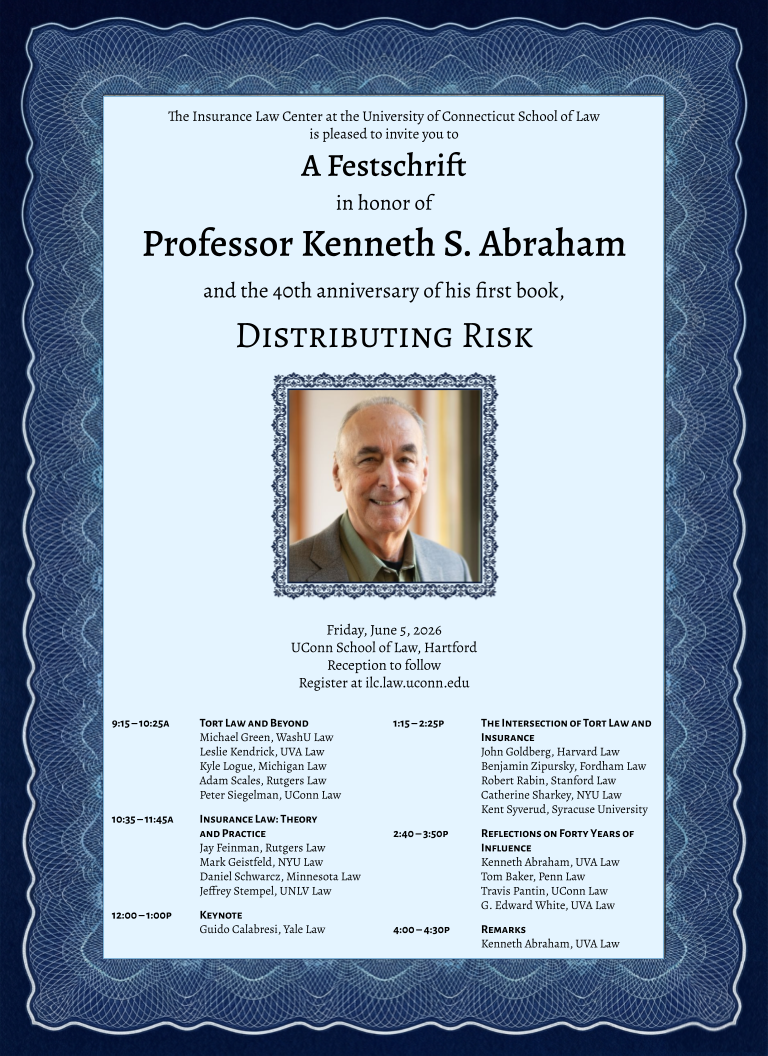
Blue conference poster that reads the following: The Insurance Law Center at the University of Connecticut School of Law is pleased to invite you to

A Festschrift

in honor of

Professor Kenneth S. Abraham

and the 40th anniversary of his first book,

DISTRIBUTING RISK

Friday, June 5, 2026
UConn School of Law, Hartford
Reception to follow
Register at ilc.law.uconn.edu

9:15 – 10:25A
TORT LAW AND BEYOND
Leslie Kendrick, UVA Law
Kyle Logue, Michigan Law
Adam Scales, Rutgers Law
Michael Green, Washington University Law
Peter Siegelman, UConn Law

10:35 – 11:45A
INSURANCE LAW: THEORY AND PRACTICE
Jay Feinman, Rutgers Law
Mark Geistfeld, NYU Law
Daniel Schwarcz, Minnesota Law
Jeffrey Stempel, UNLV Law

12:00 – 1:00P
KEYNOTE
Guido Calabresi, Yale Law

1:15 – 2:25P
THE INTERSECTION OF TORT LAW AND INSURANCE
John Goldberg, Harvard Law
Benjamin Zipursky, Fordham Law
Robert Rabin, Stanford Law
Catherine Sharkey, NYU Law
Kent Syverud, Syracuse University

2:40 – 3:50P
REFLECTIONS ON FORTY YEARS OF INFLUENCE
Kenneth Abraham, UVA Law
Tom Baker, Penn Law
Travis Pantin, UConn Law
G. Edward White, UVA Law

4:00 – 4:30P
REMARKS
Kenneth Abraham, UVA Law
  • Registration: This event is open to the public. To register, please complete the registration form before the registration deadline of May 15, 2026.
  • Location: The event will be held at the UConn School of Law, 55 Elizabeth Street, in the William F. Starr Hall Reading Room. Official location information is here. The precise Google Maps location is hereMetered parking is available, as well as free on-street parking.
  • Hotels: We have arranged limited number of rooms at the Delamar Hotel West Hartford at a discounted rate of $309/night. To book at this rate at the Delamar, please call the hotel at (860) 937-2500 and indicate that you are associated with the UConn Law event on June 5th. The deadline to book a room at this rate is May 4, 2026. Other convenient options include the Hartford Marriott Downtown and the Goodwin Hotel.
  • Questions: Please email ilc@uconn.edu.